

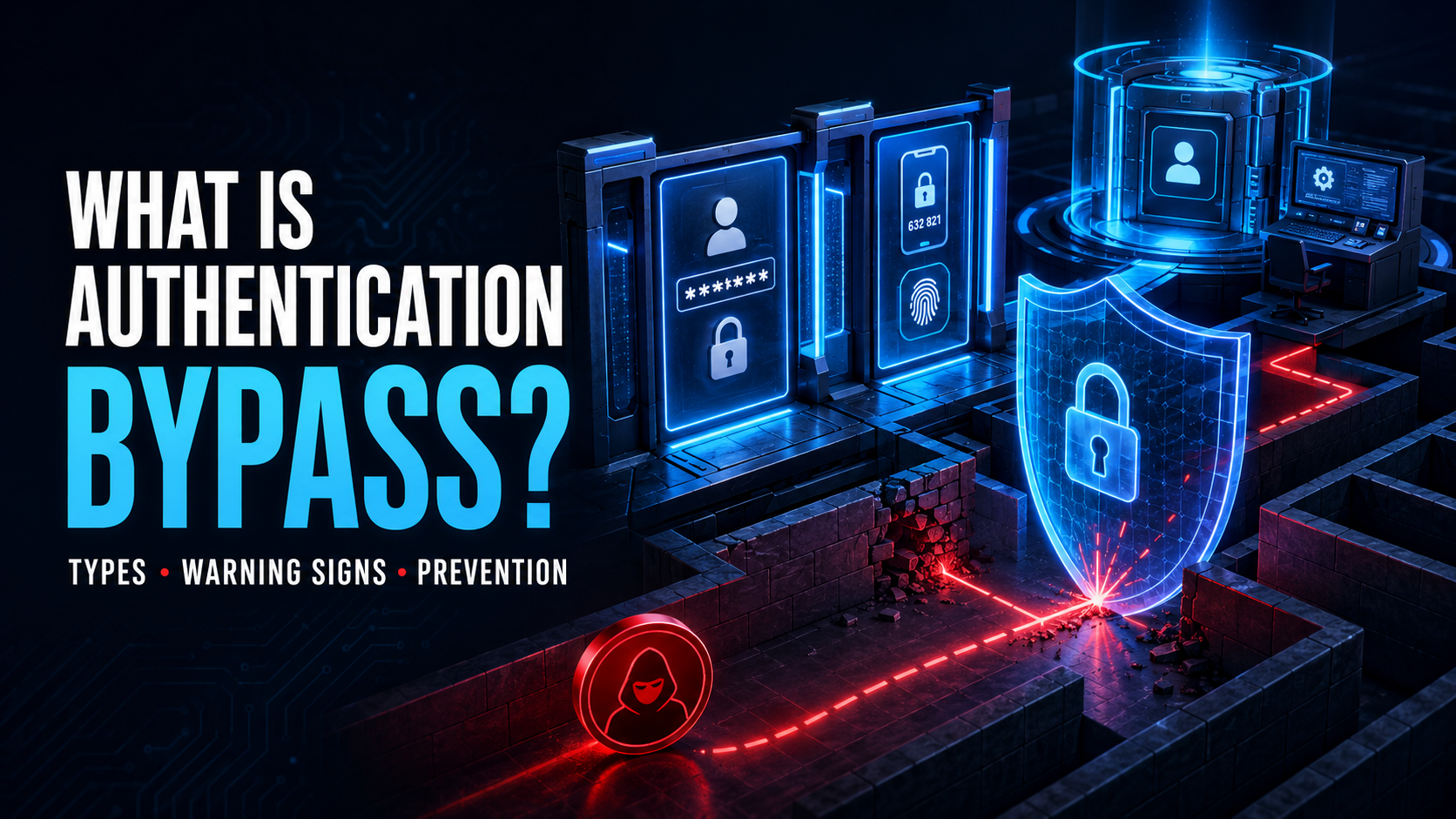
Authentication bypass is a security vulnerability that allows an attacker to access an account, application, device, or protected function without successfully completing the required identity checks.
The attacker may avoid the login process entirely, exploit an alternative route with weaker protection, manipulate a token, abuse account recovery, or take advantage of a flaw in how the application validates credentials.
A successful authentication-bypass attack may allow someone to:
- Enter another user’s account
- Reach an administrator dashboard
- Access private information
- Change security settings
- Create new accounts
- Steal or modify data
- Approve transactions
- Disable multi-factor authentication
- Generate API credentials
- Take control of the application
Authentication failures are ranked seventh in the OWASP Top 10:2025. The category includes improper authentication, session fixation, hard-coded credentials, weak certificate validation, and authentication bypass through alternate paths. OWASP’s Authentication Failures guidance explains the category.
What Is Authentication?
Authentication is the process of confirming that a user, service, or device is who it claims to be.
Common authentication factors include:
- Something the user knows, such as a password
- Something the user has, such as a security key or phone
- Something the user is, such as a fingerprint
- A trusted certificate
- A cryptographic key
- A secure session or access token
Authentication usually creates a session or token that the application uses to recognize the user during later requests.
A secure authentication system must protect the entire identity lifecycle, including:
- Registration
- Login
- Multi-factor authentication
- Password changes
- Account recovery
- Session creation
- Session renewal
- Logout
- Device enrollment
- Federation
- API authentication
If any alternate route is weaker than the main login process, an attacker may use it to bypass authentication.
How Does Authentication Bypass Work?
A typical attack follows this pattern:
- The application protects a page, API, or function with authentication.
- Another route, method, parameter, or workflow reaches the same protected resource.
- That alternative path does not enforce the same identity check.
- The attacker calls the weaker path or manipulates the authentication process.
- The application treats the attacker as authenticated.
- The attacker accesses protected data or functionality.
MITRE defines CWE-288 as authentication bypass through an alternate path or channel: a product requires authentication but exposes another route that does not. MITRE’s CWE-288 entry provides the formal classification.
Why Is Authentication Bypass Dangerous?
Authentication is the entry gate to protected application functions.
When that gate can be avoided, other security controls may receive a false identity or assume the user has already been verified.
Potential consequences include:
- Account takeover
- Identity theft
- Administrative compromise
- Financial fraud
- Exposure of customer information
- Creation of persistent accounts
- Unauthorized password changes
- Theft of authentication tokens
- Access to internal systems
- Disabling security controls
- Data deletion or manipulation
- Cloud-resource compromise
- Movement into connected services
The impact depends on which identity the attacker obtains and what that account is authorized to do.
Common Types of Authentication Bypass
Alternate Endpoint Bypass
An application may protect its normal login route while leaving another endpoint unprotected.
Possible alternate paths include:
- A legacy API
- A mobile endpoint
- An old application version
- A backup route
- A debugging interface
- An internal service
- A different hostname
- An administrative endpoint
- A direct backend address
All routes reaching protected functionality must enforce the same authentication requirements.
Missing Authentication on a Critical Function
Some functions are deployed without any authentication check.
Examples include:
- Creating users
- Changing passwords
- Viewing reports
- Exporting customer data
- Modifying system configuration
- Generating access tokens
- Managing integrations
- Uploading administrative files
MITRE classifies missing authentication for a critical operation as CWE-306. MITRE’s CWE-306 entry covers functions that should require proof of identity but do not.
Client-Side Authentication Bypass
An application may attempt to enforce authentication through:
- JavaScript
- A mobile application screen
- A hidden form value
- A local preference
- A client-side route guard
- A disabled button
The user controls the client and can bypass or modify its behavior.
Authentication must be verified by the server before processing each protected request.
Parameter Manipulation
An application may accept a client-controlled value that influences whether authentication is required.
Dangerous fields may claim that:
- The user is logged in
- MFA has been completed
- The session is trusted
- The request is internal
- The account has been verified
- A recovery check succeeded
Security state should come from trusted server-side logic, not request parameters.
Authentication Logic Flaws
Incorrect conditional logic can produce unexpected authentication results.
Examples include:
- Treating an error as success
- Skipping a required step
- Comparing the wrong value
- Accepting an empty credential
- Checking only part of a token
- Continuing after failed verification
- Using an unsafe default branch
- Applying different rules to different account types
Exceptional conditions should fail securely.
Session Authentication Bypass
A vulnerability in session handling may let an attacker use or create an authenticated session without completing login.
Potential problems include:
- Predictable session identifiers
- Session fixation
- Sessions that remain active after logout
- Missing token signatures
- Incorrect session binding
- Accepting expired sessions
- Reusing a pre-login session
- Failing to revoke stolen tokens
Session security is part of authentication security.
Session Fixation
Session fixation occurs when an attacker causes a victim to use a session identifier already known to the attacker.
If the application does not issue a new session identifier after successful authentication, the attacker may reuse the known identifier to access the authenticated session.
Applications should rotate session identifiers when authentication state changes.
Token Validation Bypass
Applications may use tokens for sessions, APIs, password resets, or federated authentication.
Authentication can fail when the application:
- Does not verify the token signature
- Accepts an inappropriate signing method
- Uses the wrong verification key
- Ignores expiration
- Fails to validate the issuer
- Fails to validate the audience
- Accepts a token intended for another service
- Trusts unverified token fields
- Confuses one token type with another
The application must validate every security-relevant property before trusting the token.
Password-Reset Bypass
Account-recovery processes can become an alternative path around login.
Potential weaknesses include:
- Predictable reset tokens
- Tokens that do not expire
- Reusable reset links
- Missing user binding
- Changing the destination address through request manipulation
- Weak security questions
- Exposed reset codes
- Resetting the password before full verification
- Account enumeration that supports targeted attacks
Recovery should not be weaker than normal authentication.
Multi-Factor Authentication Bypass
MFA may be enabled on the main login path but missing from:
- Recovery
- Mobile login
- Legacy authentication
- API access
- Remembered-device workflows
- Support-assisted account recovery
- Federated login
- Backup-code handling
OWASP notes that the procedures used to bypass, reset, or recover MFA can themselves become attack targets. OWASP’s MFA Cheat Sheet discusses secure recovery and factor replacement.
Weak Remember-Me Functionality
A “remember me” feature may issue a long-lived token that bypasses the usual login process.
Risks include:
- Predictable token values
- Missing expiration
- Tokens stored insecurely
- No revocation mechanism
- Tokens that remain valid after password changes
- Missing device information
- Lack of token rotation
Long-lived authentication tokens should be strongly protected and revocable.
Default Credentials
Applications, devices, and administrative tools may ship with default usernames and passwords.
If the organization does not change them, an attacker can authenticate using publicly known credentials.
Default credentials should be removed or changed during setup, and products should not expose shared permanent passwords.
Hard-Coded Credentials
Software may contain fixed passwords, API keys, or secret tokens in:
- Source code
- Firmware
- Mobile applications
- Configuration templates
- Container images
- Deployment scripts
Once discovered, a hard-coded credential may provide direct access and can be difficult to rotate across all installations.
Authentication Bypass Through Spoofing
An application may trust identity information from an unverified source.
Examples include:
- Client-supplied user headers
- Source IP addresses
- Easily forged device identifiers
- Unvalidated email addresses
- Unsigned identity assertions
- Reverse-proxy headers accepted from the public internet
Identity headers should be accepted only from trusted infrastructure through a protected connection.
IP-Based Authentication Bypass
Some applications treat requests from an internal or allowlisted address as authenticated.
This model may fail when:
- Proxy headers can be forged
- The trusted network is compromised
- SSRF reaches the internal service
- Cloud network boundaries are misconfigured
- Requests pass through an unexpected proxy
- IPv6 rules differ from IPv4 rules
Network location should not be the only proof of identity for sensitive functions.
Certificate Validation Bypass
Services using client certificates or mutually authenticated TLS can become vulnerable if they do not properly validate:
- The certificate chain
- Certificate expiration
- Revocation status
- Intended usage
- Hostname
- Trusted issuing authority
- Client identity
A certificate’s presence does not prove that it should be trusted.
Single Sign-On Bypass
Federated login systems may fail when the application improperly validates:
- Identity-provider signatures
- Redirect destinations
- Issuer
- Audience
- State
- Nonce
- Assertion lifetime
- Account linking
- Email ownership
SSO reduces password handling but introduces additional trust relationships that must be carefully validated.
Account-Linking Bypass
Applications may allow users to connect social, enterprise, or third-party identities.
An attacker may take over an account if the system links identities based only on matching email addresses without confirming ownership and provider trust.
Account linking should require a securely authenticated existing session or another deliberate verification step.
Race-Condition Authentication Bypass
Authentication and recovery processes may behave incorrectly when multiple requests occur simultaneously.
A race condition might allow:
- Reuse of a one-time code
- Multiple password resets
- Conflicting factor changes
- Continued access after revocation
- Approval before security state is updated
Critical state changes should be atomic and resistant to concurrent requests.
Fail-Open Authentication
A system fails open when an error causes protected access to be allowed.
This may occur when:
- The identity provider is unavailable
- A database lookup fails
- Token verification throws an exception
- The policy service times out
- A network dependency cannot be reached
- An unexpected user type is encountered
Authentication failures and system errors should result in denied access.
Authentication Bypass vs. Broken Access Control
Authentication and authorization protect different stages.
Authentication bypass allows the attacker to avoid proving their identity or impersonate another identity.
Broken access control allows an authenticated or unauthenticated user to perform an action beyond their permission.
An attacker might first bypass authentication to obtain a valid session and then exploit broken access control to reach administrator functions.
Authentication Bypass vs. IDOR
IDOR is an object-level authorization vulnerability.
A user may legitimately authenticate and then access another user’s object because ownership is not checked.
Authentication bypass occurs earlier. It lets the attacker enter without properly completing identity verification.
Strong authentication does not prevent IDOR, and strong authorization does not correct a bypassable login process.
Authentication Bypass vs. Credential Stuffing
Credential stuffing uses username-and-password combinations stolen from other services.
The attacker completes the normal login process with valid reused credentials.
Authentication bypass exploits a flaw that avoids or defeats the intended identity check.
Both may cause account takeover, but their methods and defenses differ.
Authentication Bypass vs. Brute Force
A brute-force attack repeatedly guesses passwords or codes.
Authentication bypass exploits a logic, implementation, token, session, or alternate-route weakness that avoids the need to guess the correct credential.
Rate limiting helps against brute force but may not prevent a bypass affecting another route.
Authentication Bypass vs. Session Hijacking
Session hijacking uses an authenticated session token obtained from a victim.
Authentication bypass creates or gains authenticated access by defeating the authentication process.
Session hijacking may not exploit the login function, but weak session management is included in the broader authentication-failure category.
Where Do Authentication-Bypass Vulnerabilities Appear?
Common locations include:
- Login pages
- Password-reset functions
- MFA workflows
- Mobile application APIs
- Administrative dashboards
- Legacy endpoints
- Cloud-management interfaces
- Single sign-on systems
- Account-linking functions
- Session-renewal endpoints
- Device enrollment
- API gateways
- Reverse proxies
- Internal services
- IoT devices
- Desktop applications
- Support tools
- Backup and recovery interfaces
- Developer and debugging functions
Security teams must review every channel through which identity is created, verified, recovered, or trusted.
Warning Signs of Authentication Bypass
Organizations may observe:
- Successful access without a corresponding login
- Protected requests using missing credentials
- Sessions created after failed authentication
- MFA-protected accounts accessed without an MFA event
- Password changes without a valid recovery flow
- Unusual use of legacy endpoints
- Administrator access from new devices
- Token validation errors followed by successful access
- Sessions remaining valid after logout
- Identity headers arriving directly from public clients
- Unexpected account linking
- Multiple uses of a one-time recovery code
- Login from an impossible or unusual location
- New sessions created during identity-provider outages
- Requests to hidden authentication routes
- Access using default credentials
- Unusual factor-reset activity
Monitoring should connect login, MFA, recovery, session, device, token, and account-change events.
What Causes Authentication Bypass?
Common causes include:
- Missing server-side authentication
- Inconsistent protection across endpoints
- Client-side-only login checks
- Weak token validation
- Unsafe session management
- Fail-open error handling
- Default or hard-coded credentials
- Weak account recovery
- Missing MFA on alternate paths
- Trusting spoofable headers
- Improper SSO validation
- Old APIs using weaker controls
- Incorrect proxy configuration
- Insecure account linking
- Missing expiration and revocation
- Race conditions
- Poor authentication testing
- Excessive trust in internal networks
Authentication must be designed as one consistent system covering all interfaces and workflows.
How Can Developers Prevent Authentication Bypass?
Centralize Authentication Enforcement
Use a consistent authentication service, middleware layer, gateway, or framework.
Every protected route should pass through the same security control.
Centralization reduces the risk that a new API, mobile route, or legacy function is deployed without authentication.
Deny Access by Default
Protected endpoints should remain unavailable unless the server has positively verified a valid identity.
Unknown users, malformed tokens, expired sessions, verification errors, and identity-provider failures should be denied.
Enforce Authentication on the Server
Do not trust browser or mobile logic to decide whether the user is logged in.
The server should verify the session, token, certificate, or credential before processing every protected request.
Protect Every Alternate Path
Review:
- Web interfaces
- APIs
- Mobile backends
- Legacy versions
- Administrative endpoints
- Direct backend routes
- Internal services
- Support functions
- Recovery workflows
- Background tasks
MITRE’s CWE-288 specifically emphasizes the risk of an alternate path or channel that does not require the authentication applied elsewhere.
Use Maintained Authentication Frameworks
Authentication is difficult to implement safely.
Use mature, actively maintained frameworks and identity providers rather than building custom cryptographic protocols, session formats, or password systems.
The framework still requires secure configuration and correct integration.
Validate Tokens Completely
Before trusting a token, verify:
- Signature
- Approved algorithm
- Issuer
- Audience
- Expiration
- Not-before time
- Token type
- Required claims
- Revocation status where applicable
- Intended application context
Reject unexpected algorithms, keys, issuers, and token types.
Rotate Sessions After Login
Issue a new session identifier after:
- Successful authentication
- Privilege elevation
- MFA completion
- Account recovery
- Password change
- Security-sensitive identity changes
This helps prevent session fixation and separates pre-authentication activity from authenticated sessions.
Set Secure Session Cookies
Session cookies should generally use:
- Secure
- HttpOnly
- Appropriate SameSite settings
- Restricted path and domain
- Strong unpredictable values
- Reasonable expiration
Applications should also revoke sessions when the user logs out or changes important security information.
Require Multi-Factor Authentication
MFA reduces the risk from stolen and reused passwords.
Prioritize MFA for:
- Administrators
- Financial functions
- Sensitive customer data
- Cloud-management access
- Developer and deployment systems
- Account-recovery changes
MFA must protect every authentication route, not only the primary web login.
Secure MFA Recovery
Factor-reset and recovery processes should require strong verification.
Organizations should:
- Notify the user about factor changes
- Require recent authentication where possible
- Protect backup codes
- Limit recovery attempts
- Audit support-assisted resets
- Delay or review high-risk changes
- Revoke old factors
- Invalidate suspicious sessions
Secure Password Recovery
Reset tokens should be:
- Cryptographically random
- Single-use
- Short-lived
- Bound to the correct account
- Stored securely
- Invalidated after use
- Invalidated after relevant security changes
The application should not reveal whether an account exists through noticeably different messages or timing where this creates avoidable risk.
Remove Default and Hard-Coded Credentials
Require unique credentials during installation or first use.
Store application secrets through an appropriate secret-management system and support regular rotation.
Do not embed permanent shared secrets in distributed client applications.
Protect Identity Headers
If a trusted proxy or identity-aware gateway supplies authentication headers:
- Strip client-supplied copies at the network edge
- Accept headers only from trusted proxies
- Protect the connection
- Verify the proxy’s identity
- Prevent direct backend access
- Document which component owns authentication
Use TLS Everywhere
Login pages and all authenticated application traffic should use HTTPS.
OWASP recommends protecting both authentication and post-login pages with TLS because unencrypted traffic can expose credentials or session identifiers. OWASP’s Authentication Cheat Sheet provides broader implementation guidance.
Validate SSO Responses Carefully
Federated authentication should verify all required protocol properties.
Use maintained protocol libraries and tightly control:
- Redirect URIs
- Identity providers
- Signing keys
- Issuers
- Audiences
- State and nonce
- Assertion lifetime
- Account linking
Reauthenticate for Sensitive Actions
An old authenticated session may not provide sufficient assurance for high-impact changes.
Require recent authentication or another factor before:
- Changing a password
- Replacing MFA
- Updating recovery information
- Viewing highly sensitive data
- Creating API keys
- Transferring funds
- Deleting an organization
- Changing administrator roles
Use Constant, Generic Authentication Responses
Login and recovery messages should avoid exposing unnecessary information about:
- Whether an account exists
- Whether a particular factor is enabled
- Why one credential failed
- Internal authentication state
Detailed reasons should be available in protected logs.
Apply Rate Limits
Rate-limit:
- Login attempts
- MFA codes
- Password-reset requests
- Recovery-code use
- Device enrollment
- Account linking
- Token refresh
Rate limiting does not correct a logic bypass, but it helps prevent automated guessing and abuse.
Test Failure Paths
Security testing should cover:
- Missing credentials
- Empty values
- Malformed tokens
- Expired sessions
- Revoked tokens
- Identity-provider outages
- Database failures
- Unexpected account types
- Replayed codes
- Concurrent requests
- Alternate HTTP methods
- Alternate endpoints
Exceptional conditions must fail closed.
Can a Web Application Firewall Prevent Authentication Bypass?
A WAF may block known malicious requests, automated login attacks, or access to exposed administrative routes.
It cannot reliably determine whether:
- A session was legitimately created
- MFA was completed
- A recovery token belongs to the correct user
- A federated identity was properly validated
- A backend route has missing authentication
- A business workflow was skipped
The authentication mechanism itself must be corrected.
How Should Authentication Bypass Be Tested?
Testing must be performed only with explicit authorization.
A security assessment should inventory every authentication path, including:
- Web login
- Mobile login
- API authentication
- SSO
- Password reset
- MFA recovery
- Device enrollment
- Remember-me tokens
- Session renewal
- Support-assisted recovery
- Legacy interfaces
- Administrative endpoints
Testing should verify the application’s behavior when:
- Credentials are missing
- Tokens are modified
- Sessions expire
- MFA steps are skipped
- Recovery codes are reused
- Request methods change
- Requests reach the backend directly
- Identity headers are spoofed
- Identity services fail
- Operations occur concurrently
Testing should use controlled accounts and harmless actions.
How Can Organizations Detect Authentication Bypass?
Useful monitoring sources include:
- Login logs
- Identity-provider events
- MFA records
- Password-reset activity
- Session creation
- API gateway logs
- Token-validation failures
- Reverse-proxy events
- Administrative audit logs
- Device and location information
- Account-linking events
- Cloud audit records
High-value detections include:
- Protected activity without a matching authentication event
- Successful sessions created after failed login
- MFA-enabled accounts accessed without MFA
- Direct access to backend services
- Administrator activity from new devices
- Factor changes followed by rapid sensitive actions
- Repeated malformed tokens
- Legacy endpoint use by unfamiliar clients
- Authentication success during an identity-service outage
What Should an Organization Do After Detecting Authentication Bypass?
Disable the Vulnerable Path
Temporarily disable or restrict the affected endpoint, recovery flow, token type, or legacy interface.
Place authentication enforcement in front of the exposed function while a complete fix is prepared.
Revoke Suspicious Sessions
Invalidate:
- Sessions created through the vulnerable path
- Active tokens for affected accounts
- Remember-me tokens
- Password-reset links
- Recovery codes
- Newly created API credentials
Preserve Evidence
Collect:
- Authentication logs
- Session records
- MFA events
- Token-validation errors
- Account changes
- Administrative activity
- API gateway logs
- Proxy headers
- Device and location details
- Recovery activity
Determine the Scope
Investigators should identify:
- Which accounts were accessed
- Which identity was impersonated
- Whether administrators were affected
- What data was viewed
- What settings were changed
- Whether new accounts or tokens were created
- Whether the attacker established persistence
- Whether connected services were accessed
Reverse Unauthorized Changes
Restore:
- Passwords
- MFA settings
- Recovery information
- Account roles
- API credentials
- Connected applications
- Security settings
- Modified or deleted data
Rotate Exposed Secrets
If the attacker accessed administrative systems or configuration, rotate potentially affected:
- API keys
- Signing keys
- Session secrets
- Database credentials
- Cloud credentials
- Service-account tokens
- Administrative passwords
Notify Affected Users
Tell affected users what happened, which information or settings were involved, and what actions they should take.
Follow applicable legal and regulatory notification requirements.
Fix Every Authentication Channel
Do not correct only the discovered endpoint.
Review the entire authentication system, including web, mobile, APIs, SSO, recovery, support, and legacy routes.
Continue Monitoring
Watch for:
- Reuse of revoked sessions
- New account activity
- Repeated bypass attempts
- Use of stolen data
- Suspicious API tokens
- Further privilege escalation
- Access to connected systems
- New persistence mechanisms
What Should a User Do After Suspected Authentication Bypass?
If your account was accessed without your permission:
- Use the service’s official website or application.
- Change your password.
- Sign out all other sessions.
- Enable or reset MFA.
- Review recovery email addresses and phone numbers.
- Remove unfamiliar devices.
- Revoke unknown connected applications.
- Delete unauthorized API keys.
- Review account and financial activity.
- Contact the service provider.
If the provider’s login system contains a vulnerability, changing the password alone may not solve the underlying problem, but it can protect against any credentials exposed during the incident.
Does MFA Completely Prevent Authentication Bypass?
No.
MFA provides powerful protection against stolen passwords, credential stuffing, and many account-takeover attempts.
However, an attacker may bypass authentication if another route:
- Does not require MFA
- Incorrectly trusts a session
- Has weak account recovery
- Accepts an invalid token
- Exposes a direct backend endpoint
- Fails open during an error
MFA must be enforced consistently across the entire authentication system.
Does HTTPS Prevent Authentication Bypass?
HTTPS protects credentials and session tokens in transit.
It does not correct missing authentication, flawed token validation, weak recovery, or an unprotected alternate endpoint.
A bypass can occur over a correctly encrypted connection.
Can Authentication Bypass Affect APIs?
Yes.
Common API-related causes include:
- Missing authentication middleware
- Inconsistent gateway coverage
- Trusting client-supplied identity headers
- Incorrect access-token validation
- Exposed internal endpoints
- Legacy API versions
- Missing authentication on alternate methods
Every non-public API route should independently verify a valid identity.
Can Authentication Bypass Lead to Account Takeover?
Yes.
If the attacker can make the application accept them as another user, the result is effectively account takeover.
The attacker may also create lasting access by changing recovery details, enrolling a new factor, creating API keys, or adding an external identity.
Is Authentication Bypass in the OWASP Top 10?
Authentication bypass is covered by A07:2025 – Authentication Failures in the OWASP Top 10:2025.
The category includes weaknesses such as improper authentication, session fixation, missing authentication for critical functions, and authentication bypass through alternate paths. OWASP Top 10:2025 documents the current category.
